Start Designing for Free!
By Bliss & Bone
March 2026
Save the date etiquette comes down to a few firm rules and a handful of areas where modern conventions have shifted considerably. The non-negotiables: only send save the dates to guests who will receive a formal wedding invitation, include names and date but leave venue and registry details off entirely, and address envelopes in a way that clearly communicates who is—and isn't—invited.
This guide covers what belongs on a save the date, how to address them for every guest type, plus one rules, wording examples, digital etiquette, and destination wedding conventions.
A save the date needs four things: the couple's names, the wedding date, the city and state (or country, for destination weddings), and a line noting that a formal invitation will follow. That last element matters: guests receiving a save the date for the first time should know a full invitation is coming later.
Your wedding website URL belongs here too. Guests check the website immediately once the date is on their calendar, and a live link gives them travel details, accommodation recommendations, and FAQs before you've finalized every logistical detail.
What doesn't belong: the venue name and address, registry links, meal choices, the ceremony schedule, or any RSVP request. Those details live on the formal invitation. Including them on a save the date blurs the distinction between the two pieces and can confuse guests about what the invitation will add.
Everyone who will receive a wedding invitation should receive a save the date. This is the foundational rule of save the date etiquette, and etiquette experts at Emily Post have emphasized it clearly: once someone receives a save the date, you've made an implicit commitment to follow it with a formal invitation. A guest who is sent a save the date and then does not receive an invitation has been treated discourteously, having arranged their schedule and possibly made travel plans around your event.
The practical implication: finalize your guest list before you send anything. If you're still debating whether to include certain people, hold off. A secondary list of guests you might invite depending on RSVPs from your primary list should not receive save the dates.
Save the dates don't need to go to vendors, your officiant, or members of your wedding party unless you want those people to formally mark the date the way your guests would. They're typically notified through direct communication.
The save the date is the first place you communicate who is invited, including whether guests are receiving a plus one. If a guest is getting a plus one, the envelope should reflect that. Addressing a save the date to "Sarah Mitchell and Guest" explicitly signals that she may bring a companion. An envelope addressed only to "Sarah Mitchell" signals no plus one.
This specificity matters. If a guest assumes a plus one is included and makes plans accordingly, the situation at your wedding is uncomfortable for everyone. Getting the addressing right on the save the date sets clear expectations before the formal invitation arrives.
Couples who aren't sure yet whether they can accommodate plus ones for certain guests can send save the dates addressed to individuals only, and communicate the plus one decision at the invitation stage. Be prepared that some guests will ask directly once they receive a save the date addressed only to them.
How you address a save the date communicates exactly who is invited. Every household type has a specific convention.
Married couples sharing a household receive one envelope addressed to both partners using their preferred names. "Mr. and Mrs. James Carter" suits traditional preferences; "James and Meredith Carter" works when they share a last name; "Meredith Okonkwo and James Carter" is the format for couples with different surnames. When both partners hold professional titles, use both: "Dr. James and Dr. Rachel Hoffman," or "Dr. Rachel Hoffman and Dr. James Hoffman" if they share a last name.
Unmarried couples living together receive one envelope addressed to both partners: "Sarah Patel and David Rosenberg." Unmarried couples at separate addresses each receive their own save the date.
Single guests not receiving a plus one are addressed individually by full name and title: "Ms. Priya Mehta." If they're receiving a plus one, add "and Guest" to the envelope.
Families with children invited to the wedding should be addressed as a family: "The Carter Family," or list the children's names below the adults if the family is addressed formally. If children are not invited, address the envelope only to the adults and omit children's names. This communicates the scope of the invitation without requiring an explicit conversation.
Guests with titles—physicians, military officers, judges, members of clergy—use their full formal title: "Dr. Rachel Hoffman," "Colonel and Mrs. David Park," "The Honorable Christine Walsh." When military or government titles apply to one partner, the titled person is listed first.
Return address belongs on the envelope: use the address where you want correspondence sent, typically one partner's current address. For digital save the dates, the sender name and reply-to email address serve the same purpose. For complete addressing formats covering every guest scenario, the conventions in the wedding invitation addressing guideapply equally to save the dates.
Save the date wording should be brief. The card delivers one message: a date is coming, a formal invitation follows. There's no need for elaborate language or ceremony.
Standard wording:
Please save the date. [Month Day, Year] [City, State] [Partner One] and [Partner Two] are getting married. Formal invitation to follow. [wedding website URL]
Casual wording:
We're getting married. [Date] | [City] Details at [website URL] — formal invitation coming soon.
Destination wording, for weddings where guests need to understand that travel is required, benefits from an added line:
We're getting married in [City, Country]. [Date] Start planning your trip — [website URL] Formal invitation to follow.
For a full set of templates organized by style: formal, casual, destination, and elopement announcement, see save the date wording examples.
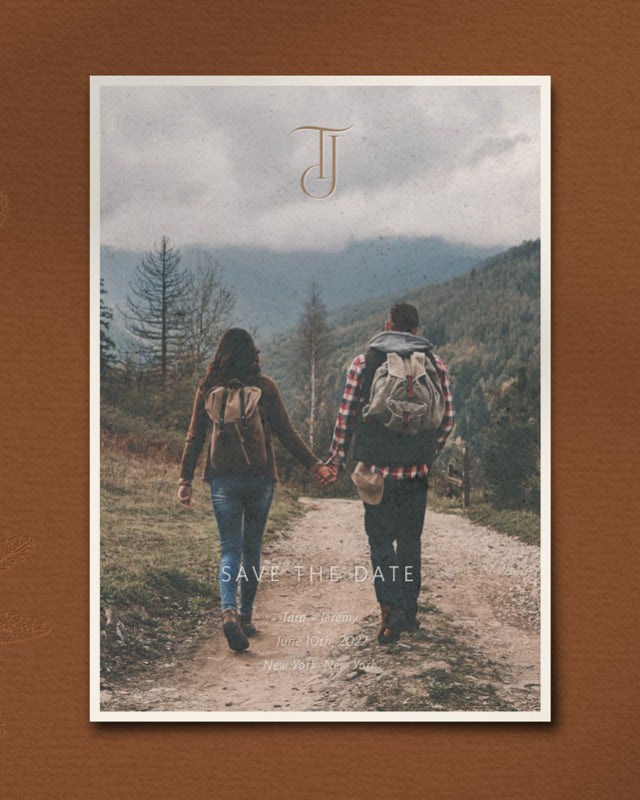
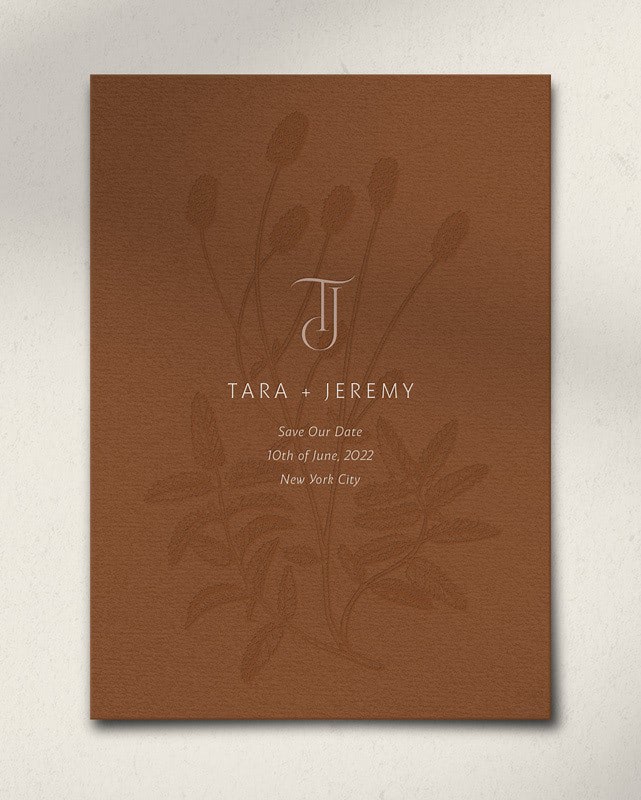
Digital save the dates are fully accepted across all guest demographics. The etiquette considerations differ slightly from printed versions, but the core rules are identical: same addressing conventions, same content requirements, same obligation to follow up with a formal invitation.
The main digital-specific issue is deliverability. Email addresses go stale, spam filters catch unsolicited messages, and guests don't always add the sender to their contacts. Send digital save the dates from a recognizable address with both partners' names visible in the sender field, and follow up with a quick text or call to anyone who hasn't acknowledged receipt within a week or two.
A hybrid approach is entirely appropriate: digital save the dates for most guests, printed versions for older family members or guests who may not check email reliably. At Bliss & Bone, online save the dates are designed to match our printed invitation suites, so couples who go hybrid don't have to sacrifice visual consistency across formats. For design options in the digital format specifically, see digital save the dates.
Destination weddings require earlier send dates and more information than domestic celebrations. Beyond names, date, and city, a destination save the date should make clear that travel is required and direct guests to your wedding website for accommodation details, travel logistics, and any hotel room block information once it's confirmed.
Guest list decisions are different for destination weddings too. Because travel represents a meaningful financial and logistical commitment for guests, sending save the dates to people you'd love to invite but don't genuinely expect to attend places them in an awkward position. Be deliberate about who's on the list before anything goes out.
For timing guidance specific to destination weddings, which have meaningfully different lead time requirements than domestic celebrations, see when to send save the dates.
Save the dates aren't required, but they're strongly recommended for any wedding where guests need to arrange travel or request time off. A small, local wedding with a guest list of 20 people who all live nearby can skip them. For anything larger, or any wedding with out-of-town guests, save the dates are effectively essential.
A save the date is informal advance notice: it claims the date and prompts guests to start planning. A formal invitation is the official request to attend, delivering the details: venue address, ceremony time, reception information, RSVP instructions, and meal choices. Save the dates go out 6 to 8 months before the wedding; invitations follow 6 to 8 weeks out.
Yes. A save the date creates an obligation to follow it with a formal invitation. If someone receives a save the date and is later not invited, it's a significant slight: they've arranged their schedule around your event based on an implied commitment. This is the reason guest list finalization before sending matters.
No. The save the date is not the invitation. Guests respond to formal invitations; save the dates are informational notices. Including an RSVP request on a save the date signals that you're treating it as a combined invitation, which creates confusion about what the formal invitation will add.
There's no etiquette requirement that they match, but visual cohesion across save the dates, invitations, and wedding website creates a polished impression. A matching suite, with the same colors, typography, and design language across all three, is the standard approach for formal and semi-formal weddings. For casual celebrations, mismatched pieces are entirely acceptable.
Once you have the etiquette sorted, the next step is designing the actual card. Bliss & Bone's online save the dates let you send instantly with no printing turnaround, or you can browse printed save the date designs if you prefer something physical. Both collections follow the same design system, so switching formats later doesn't mean starting over.