



Start Designing for Free!
By Bliss & Bone
February 2026
Addressing wedding invitations correctly makes a lasting first impression on your guests and sets the tone for your entire celebration. This guide covers every common scenario — married couples, families, plus ones, same-sex couples, divorced guests, widows, and guests with professional titles — with outer and inner envelope examples for each. For broader guidance on wording and timing, see our complete guide to wedding invitation etiquette.

Most couples today use a single outer envelope — two envelopes is a traditional touch that was once standard practice but is less common now. The examples in this guide show both outer and inner envelope conventions. If you only have one envelope, use the outer envelope format — formal titles and full names — for everyone invited, including children and plus ones. For sizes, liners, sealing, and whether you need both, see our complete guide to wedding invitation envelopes.
Outer envelope
What the postal service sees. Use formal titles and full names. Return address goes on the back flap. Do not list children.
Inner envelope
What the guest sees when they open it. Use first names only. List all invited guests including children. Write 'and Guest' or the plus one's name if known.
Once you know who to address, the next decision is how the address actually gets onto the envelope. There are three main approaches:
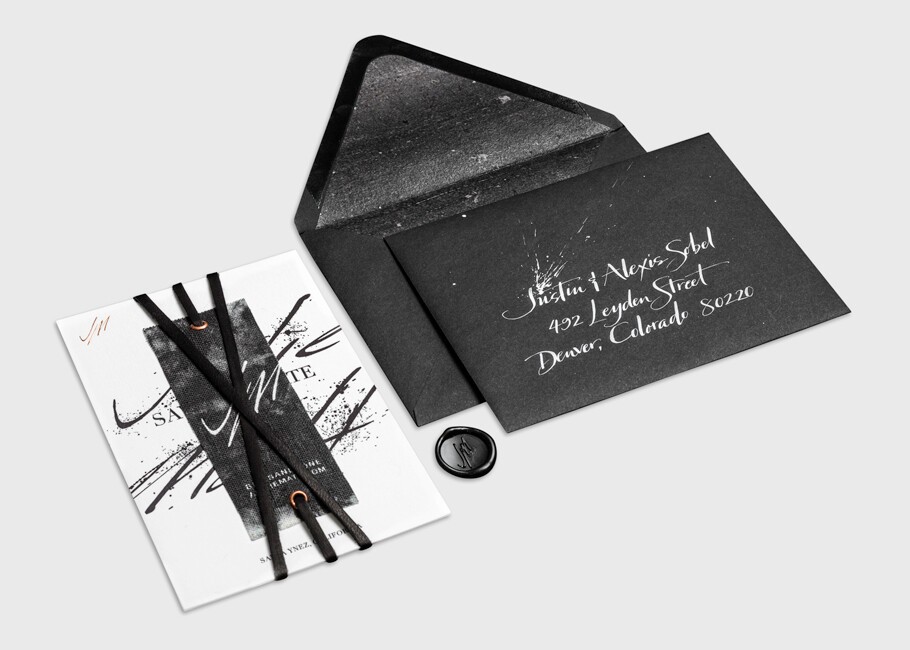
Calligraphy is the most traditional and elegant option. A professional calligrapher hand-letters each envelope in ink, typically charging $4–10 per envelope. Book early, because calligraphers fill up fast during peak wedding season. If you're going the calligraphy route, provide a clean, formatted spreadsheet of every guest address to avoid transcription errors.
Printed labels are the most practical option for large guest lists. Use a clean serif or sans-serif font that matches your invitation suite, print on clear labels, and apply them straight. Avoid decorative script fonts, since they're harder to read and postal scanners can reject them.
Digital printing directly on the envelope sits between the two — cleaner than labels, cheaper than calligraphy. Many online stationery services including Bliss & Bone offer this as an add-on when you order printed invitations.
Regardless of method, follow these formatting rules:
The key rule: list both people clearly, using their actual names and titles. Never assume a shared last name.
Married couple, same last name
Outer: Mr. and Mrs. James Anderson
Inner: James and Sarah
Wife kept maiden name
Outer: Ms. Sarah Collins and Mr. James Anderson
Inner: Sarah and James
Same-sex couple (two grooms)
Outer: Mr. David Park and Mr. Thomas Rivera
Inner: David and Thomas
Same-sex couple (two brides)
Outer: Ms. Jennifer Hall and Ms. Priya Mehta
Inner: Jennifer and Priya
Non-binary guest (Mx. title)
Outer: Mx. Jordan Ellis and Ms. Claire Barnes
Inner: Jordan and Claire
One spouse took hyphenated last name
Outer: Mr. Marcus Craft and Mr. Brian Crosby-Craft
Inner: Marcus and Brian
Unmarried couple living together
Outer: Ms. Rachel Moore
Mr. Kevin Walsh (each on a separate line)
Inner: Rachel and Kevin
For unmarried couples living together, list each person on a separate line on the outer envelope. The order can be alphabetical or the person you know better listed first — either is fine.
On the outer envelope, address the parents only. Use the inner envelope to list everyone invited by name, including children.
Family with young children
Outer: Mr. and Mrs. Robert Hayes
Inner: Robert, Jennifer, Emma, and Liam
Family with adult child (18+) at same address
Outer: Mr. and Mrs. Robert Hayes
Inner: Robert and Jennifer (send a separate invitation to the adult child)
Single parent family
Outer: Ms. Patricia Nguyen
Inner: Patricia, Daniel, and Lily
Important: Any child 18 or older should receive their own invitation, even if they live at the same address. This applies to college students home for the summer as well.
When children are not invited
The cleanest way to communicate a child-free wedding is through your wedding website and word of mouth — not the invitation itself. Address the outer envelope to the adults by name only. On the inner envelope, write the adults' first names only — no "and family." The absence of children's names signals clearly that only the named guests are invited.
Use 'and Guest' when you don't know the plus one's name, or their full name once you do. If you're using two envelopes, 'and Guest' belongs on the inner envelope only — once you have their name, update the inner envelope accordingly.
Guest with unknown plus one
Outer: Ms. Olivia Bennett and Guest
Inner: Olivia and Guest
Guest with known plus one
Outer: Ms. Olivia Bennett and Mr. Samuel Price
Inner: Olivia and Samuel
Guest with no plus one
Outer: Ms. Olivia Bennett
Inner: Olivia
When RSVPs come in, collect the plus one's full name for place cards and catering records. Your wedding website is a great place to capture this — include a field for guest name in your RSVP form.
Always use the higher-ranking title first. If both guests hold the same title (e.g., two doctors), 'The Doctors [Last Name]' works elegantly when they share a name.
One doctor (male)
Outer: Doctor and Mrs. Michael Torres
Inner: Michael and Diana
One doctor (female)
Outer: Mr. James Patel and Doctor Rachel Patel
Inner: James and Rachel
Both doctors, same last name
Outer: The Doctors Carter
Inner: Jonathan and Maria
Both doctors, different last names
Outer: Doctor Elena Vasquez and Doctor Brian Kim
Inner: Elena and Brian
Military officer
Outer: Captain and Mrs. William Scott, USA
Inner: William and Margaret
Judge
Outer: The Honorable Sandra Lee and Mr. Richard Lee
Inner: Sandra and Richard
Lawyer
Outer: Ms. Caroline Hughes, Esq. and Mr. Paul Hughes
Inner: Caroline and Paul
Reverend / Pastor
Outer: The Reverend and Mrs. Mark Davis
Inner: Mark and Susan
Catholic priest (guest only)
Outer: The Reverend Father Thomas O'Brien
Inner: Father Thomas
For military titles, spell out the full rank and branch on formal invitations. Retired officers may still use their rank — confirm with the guest's preference if you're unsure.
Use whatever name the guest currently uses. If you're unsure, check with a mutual friend rather than guess.
Divorced woman using married name
Outer: Mrs. Angela Morrison
Inner: Angela
Divorced woman using maiden name
Outer: Ms. Angela Cooper
Inner: Angela
Widow
Outer: Mrs. Florence Grant
Inner: Florence
Remarried with hyphenated name
Outer: Ms. Christine Park-Williams
Inner: Christine
Use their title and full name on the outer envelope. On the inner envelope, first name only. If they have no plus one, address it solely to them — adding 'and Guest' when you haven't offered one creates confusion and obligation.
Single guest, no plus one
Outer: Ms. Diana Foster
Inner: Diana
The return address goes on the back flap of the outer envelope — never the front. Use the address RSVPs should come back to, which may be the couple, the bride's parents, or a wedding planner's address depending on your setup.
Format: No 'From:' label needed. Write or print the host's full name and address centered on the back flap.
For printed envelopes, consider having the return address engraved or digitally printed in the same typeface as the invitation for a cohesive look. For handwritten envelopes, match the style of the address lettering.
Yes — use full first and last names on the outer envelope with formal titles. The inner envelope is more relaxed and typically uses first names only.
Address the outer envelope to the parents only (e.g., 'Mr. and Mrs. Robert Hayes'). List all invited family members by first name on the inner envelope. Send separate invitations to any household members 18 or older.
List both names in full with their respective titles, either on one line or two: 'Ms. Sarah Collins and Mr. James Anderson.' There's no required order — alphabetical or by personal preference both work.
Write the guest's name followed by 'and Guest' on the outer envelope. On the inner envelope, write their name and 'and Guest' or the plus one's actual name if you have it.
Use 'Mrs.' followed by her full married name if she has kept it, or 'Ms.' with her current name. Never address a widow as 'Mrs. [Her First Name] [Married Last Name]' — that format is used for divorced women, not widows.
If they share a last name: 'The Doctors Carter.' If they have different last names: 'Doctor Elena Vasquez and Doctor Brian Kim.' Never abbreviate 'Doctor' as 'Dr.' on formal wedding invitations.
Traditional etiquette lists the husband first (e.g., 'Mr. and Mrs. James Anderson'), but modern practice is flexible. For same-sex couples or couples who prefer otherwise, alphabetical order or personal preference both work.
Address it solely to them — 'Ms. Diana Foster' on the outer envelope, 'Diana' on the inner. Only add 'and Guest' if you're actually extending a plus one.
Use the same approach as any couple — list both full names with their preferred titles. If they share a last name and both use Mr.: 'Mr. David and Mr. Thomas Park.' If different last names: 'Mr. David Park and Mr. Thomas Rivera.'
Use 'The Honorable' followed by their full name on the outer envelope: 'The Honorable Sandra Lee and Mr. Richard Lee.' On the inner envelope, first names are sufficient.
Once you know how to address your envelopes, the next step is designing the invitations themselves. Bliss & Bone offers fully customizable printed and digital wedding invitations, matching RSVP cards, and wedding websites with built-in RSVP collection — so you can capture guest names, dietary needs, and plus-one details automatically. For a complete overview of timing, wording, and etiquette, visit our wedding invitation etiquette guide.