



Start Designing for Free!
By Bliss & Bone
July 2026
Send save the dates 6 to 8 months before your wedding date. That window gives guests enough notice to arrange travel, block time off work, and book accommodations without last-minute scrambling. For destination weddings, extend that to 8 to 12 months. International guests booking flights, hotels, and extended leave need considerably more lead time.
Four variables shape when to send out save the dates: whether your wedding is local or destination, whether most guests are traveling, whether your date falls on a holiday weekend, and whether you're sending digital or printed save the dates. The sections below cover each scenario with specific numbers.
Send out save the dates 6 to 8 months before the wedding for a domestic wedding with a mostly local or regional guest list. That's the standard rule, and it's the answer for the majority of couples.
If a meaningful portion of your guests need flights and hotels (friends in other cities, family spread across the country), lean toward 8 months rather than 6. More runway means fewer last-minute logistics for them, and fewer last-minute regrets for you.
Holiday weekend weddings are the exception to the standard rule. If your date falls on Memorial Day weekend, Labor Day, Fourth of July, or a long weekend in peak travel season, send save the dates 10 to 12 months out. Guests are competing for flights, hotel availability, and their own family calendar during those windows. The earlier your save the date arrives, the better your chance of landing ahead of competing commitments.
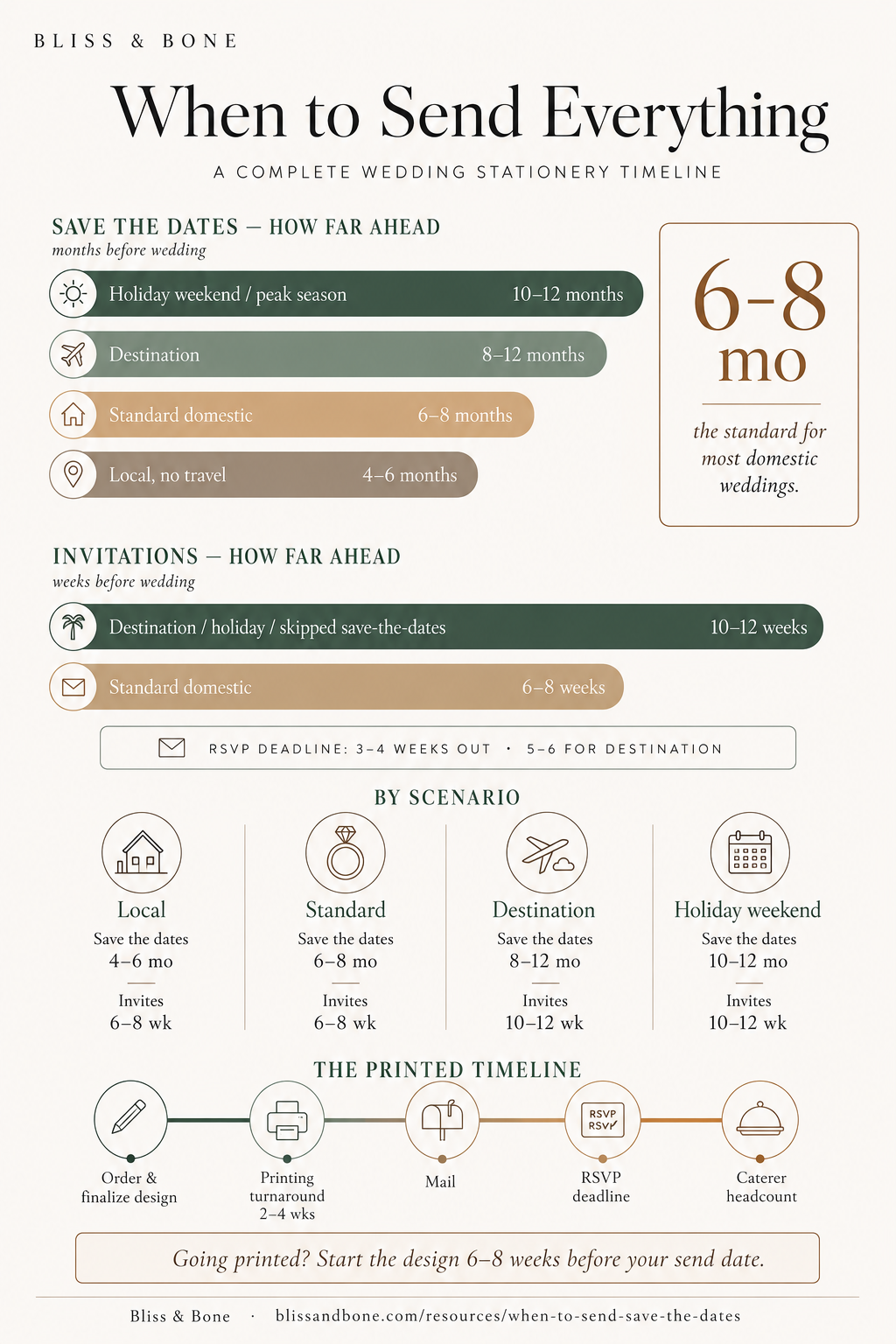
Destination weddings require a minimum of 8 to 12 months. International destinations (a villa in Tuscany, a resort in the Mexican Caribbean, a château in France) call for 12 months. Guests booking international travel need time to shop for fares, confirm vacation time with their employer, apply for passports if needed, and coordinate with travel companions.
Domestic destination weddings sit at 8 to 10 months. A mountain lodge in Colorado, a beach house on the Outer Banks, a vineyard in Sonoma: these require the same planning effort as international travel (flights, lodging, days off), just without the passport and foreign booking layer.
Your save the date is the right place to include your wedding website URL so guests can access travel details, accommodation recommendations, and your hotel room block information as soon as the date is on their calendar. The room block doesn't need to be finalized before you send. It can be added to the website once it's confirmed. Get the website live and link to it from the start. As your guest list takes shape, a wedding guest list template keeps travel details, contact info, and RSVP status organized in one place.
Local weddings, where most guests are within driving distance and won't need to book travel, still work best on the standard 6-to-8-month window. No flights, no hotels, no vacation days to coordinate, so the urgency is lower, but the calendar problem doesn't change.
Six months is the floor for a fully local guest list. Weekends fill up fast. People book trips, commit to other events, and make plans well in advance. A guest who receives your save the date 6 months out can decline a competing event. A guest who receives it 10 weeks out may already have something locked in.
The cost of sending a few months early is negligible. The cost of sending too late is a depleted RSVP.
Digital save the dates skip production and postal delivery time, which gives you more flexibility in preparation, but the target send date should be the same. Your guests need 6 to 8 months of notice regardless of the format.
The practical difference is in preparation lead time. Printed save the dates require design finalization, a printing turnaround of 2 to 4 weeks, and postal delivery time. If you're using a photo save the date, your engagement photos need to be shot and edited before that clock even starts, so it's ideal to plan the session three to six months ahead. Start the design process 6 to 8 weeks before your target send date if you're going the printed route. For digital, design-to-send takes days, not weeks. Bliss & Bone's online save the dates are sent digitally with no production window, and designed to match our printed invitation suites if you're coordinating a hybrid send.
Once save the dates are out, invitations follow 6 to 8 weeks before the wedding. Save the dates claim the date; invitations deliver the formal details—venue address, ceremony time, RSVP deadline, and meal choices if applicable.
One mistake worth avoiding: sending save the dates 12 months out and then waiting until 3 months before the wedding to send invitations. That gap creates an information vacuum. Guests have the date blocked but no formal invite in hand, no RSVP to submit, and no official confirmation of where to be. Send the invitation as soon as your venue logistics, ceremony details, and RSVP platform are ready to go. There's no benefit to waiting.
For a full breakdown of invitation timing by scenario, including destination weddings, digital vs. printed, and weddings without save the dates, see when to send wedding invitations.
For etiquette questions, including what goes on a save the date, how to address them, and plus one rules, see save the date etiquette.
Send out save the dates 6 to 8 months before the wedding for a standard domestic wedding, 8 to 12 months for a destination wedding, and 10 to 12 months if your date falls on a holiday weekend. Local weddings where nobody's traveling sit at the low end of the standard window, with six months as the floor. The rule of thumb: the more travel and calendar coordination your guests face, the earlier you send.
You don't send them together—they're two separate mailings on two different clocks. Save the dates go out 6 to 8 months before the wedding to claim the date; invitations follow 6 to 8 weeks before the wedding with the formal details. If you're skipping save the dates altogether, send invitations earlier, at 10 to 12 weeks out, to make up for the missing advance notice.
Twelve months before the wedding is the outer limit, and only appropriate for complex international destination weddings. Beyond that, guests struggle to mentally commit to an event that still feels distant, travel can't be meaningfully booked that far in advance, and any early-planning changes to your date or venue will require sending revised information to your entire list.
No. Lock in the venue and sign the contract before anything goes out. If you send save the dates and later change the date or location, you'll need to send "change the date" notifications, which causes confusion, erodes confidence in your planning, and adds unnecessary cost and effort. Venue confirmation is a prerequisite.
Ten to twelve months before the event. Holiday weekends create immediate scheduling conflicts for guests: family traditions, competing events, accommodation price spikes, travel rushes. Getting your save the date to guests before those conflicts lock in is the entire point of sending one.
Yes. If you skip save the dates entirely, push invitations to 10 to 12 weeks before the wedding to compensate for the missing advance notice. For destination weddings, skipping save the dates is not recommended, as the planning timeline is too compressed without advance notice, and guests booking international travel need significantly more lead time than a 12-week invitation window provides.
Eight to twelve months before the wedding. International destinations call for the full 12 months; domestic destination weddings land comfortably at 8 to 10 months depending on how far guests are traveling and how logistically complex the trip is.
Once the timing is set, the next decision is format. Bliss & Bone's online save the dates can be designed and sent in a day, with no printing turnaround, no postage. If you want something physical, browse printed save the date designs that ship in time for any of the windows covered above.